
Documents Among St. Mary's Deeds
St. Mary's County deed records live with the Circuit Court Clerk's Department of Land Records. Deeds are only part of that system. Mortgages and deeds of trust sit beside releases, liens, easements, powers of attorney, some leases, assignments, and road dedications. All of them are instruments that affect a legal interest in land. The label on the instrument matters. A deed conveys an interest. A mortgage secures a debt, and a release shows that an earlier claim was discharged. Read the indexed instrument type and the recorded document itself. Draw conclusions only after both.
| Deed Type | What It Does | Common Use |
|---|---|---|
| General warranty deed | Conveys the stated interest with broad title promises | Ordinary arm's-length conveyances |
| Special warranty deed | Limits the grantor's promises to a stated period | Some business and fiduciary transfers |
| Quitclaim deed | Conveys whatever interest the grantor may hold | Family transfers or title cleanup |
| Trustee or personal-representative deed | Conveys through a trust, estate, or court process | Estate administration and trust property |
| Deed of trust | Secures a loan rather than conveying a clean ownership history | Mortgage financing and later releases |
A recorded deed proves the conveyance it states. It proves nothing more. Liens, estate disputes, easements, and competing claims can all survive alongside a clean-looking deed record. A careful chain of title review therefore tracks later releases and court orders. It tracks the conveyances themselves just as closely. Maryland Courts is blunt on the limits here: clerks can locate land records and provide copies. But they cannot perform a title search, judge whether a form meets a legal goal, or offer legal advice.
St. Mary's Land Records Portal
Maryland Land Records, better known as MDLandRec, is the official online route to St. Mary's deed images and indexes. A free Maryland State Archives account unlocks it. The landing page exposes an Indices area and a Jump to New Volume tool for moving between land-record books. Address search is not the primary deed route, though. When only a street address is known, start with SDAT or the county GIS map, capture the owner of record and the Liber/Folio, then carry those into the land index.
| Portal control | Input | How it helps |
|---|---|---|
| Email and password | Free account credentials | Opens index and image access |
| Clerk | St. Mary's Clerk | Sets the correct county series |
| Book and page | Liber/Folio citation | Jumps to a known recorded page |
| Indices | Grantor or grantee name | Locates a citation when no book/page is known |
Not every live filter or modern image cutoff is visible from the public login. An absent online image is a cue, not a verdict. It should send you to another volume, the courthouse terminal, or the Clerk. Don't conclude that no deed exists before checking those. The Maryland Courts land-record guide confirms public access to the records. It also spells out the copy route.
The Maryland Land Records home screen displays the account login alongside the Indices area and volume-jump navigation.
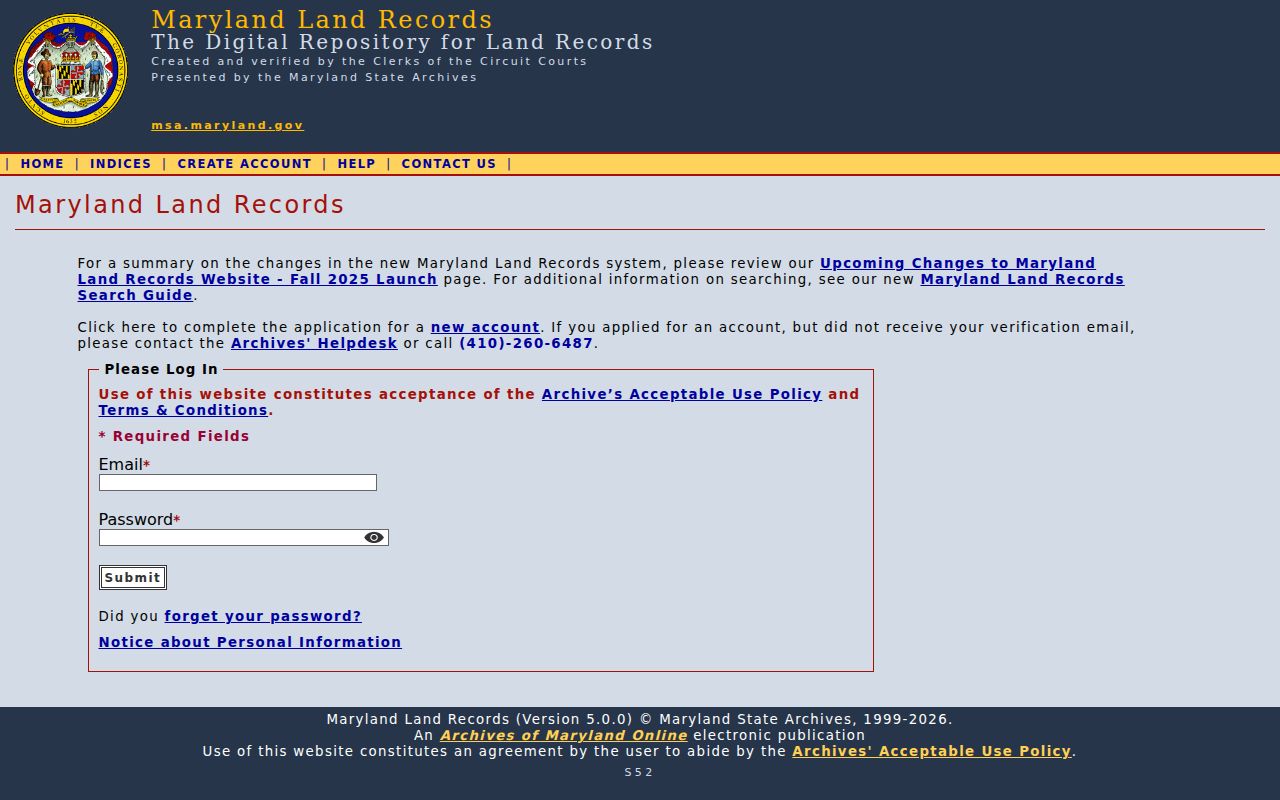
The screen itself explains why an owner name or Liber/Folio should come before any hunt for a deed image.
Trace St. Mary's Grantors and Grantees
The grantor gives. The grantee receives. That simple pair of roles powers every St. Mary's County deed search. The local grantor-grantee index ties each name to the clerk initials, land-record book, and page where an instrument was recorded. This index is the core method for rebuilding a chain of title. The current deed names the prior owner of record, and that name becomes the next search key as you walk the chain backward. Compare legal descriptions at every step, because one person or entity may have held more than one parcel in the county.
- Use the current SDAT record's Liber/Folio or search the current owner as a grantee.
- Open the deed and record its grantor, grantee, date, legal description, and book/page citation.
- Search the grantor as an earlier grantee. Match acreage, tract or lot, adjoining owners, and road or water references.
- Repeat one transfer at a time. Branch to deed books, abstracts, plats, tax lists, or probate when the index trail breaks.
- Grantor
- The person or entity conveying the stated interest.
- Grantee
- The person or entity receiving that interest.
- Chain of title
- The linked series of conveyances for the same land.
- Liber/Folio
- The book and page citation used to retrieve a recorded instrument.
Names alone make weak matches. Hold on to middle initials, entity suffixes, trustee roles, dates, acreage, and the exact property wording as you move through the deed records. An estate or trust can throw in another wrinkle, since the chain may not make sense until you pull the probate record that sits between two deeds.
St. Mary's Deed Index Time Depth
Deed records in St. Mary's County stretch across several overlapping systems. The Maryland State Archives documents an electronic land-record index covering 1827 through 1950. Original grantor and grantee index series begin in 1930 and reach 1992, with paper and microfilm companions alongside. Historical land-record series reach back to 1777. Those dates describe distinct record series, not a promise that a deed image for every year sits on the live portal.
Precision matters here. Use MDLandRec for current books and visible images. Consult the Archives guide for named historical series, and ask the Clerk where the current electronic volume boundary falls. That approach keeps an online gap from being mistaken for a gap in the courthouse record.
Coverage has layers. The documented historical indexes have firm series dates, while the current St. Mary's online image cutoff was not published on the login page.
The 1831 St. Mary's Record Break
On March 8, 1831, fire swept the St. Mary's County courthouse and destroyed most of the early court and land records. The St. Mary's County Historical Society reports that deeds from 1637 through 1831 were lost. One re-recorded volume survives, and it starts in the late 1700s. That break shapes how any old chain should be described. A post-fire chain can run complete through the surviving books. But the conveyance that formed the original tract stays missing.
Substitutes survive. St. Mary's land abstracts covering 1806-1874 preserve parties, property descriptions, purchase amounts, and recording dates. Rent rolls, debt books, tax assessments, patents, division plats, probate records, and surveyor journals can each bridge a fact. Each remains a clue of its own type. None deserves promotion into an unbroken title conclusion.
The Historical Society's land and tax collection shows the local substitutes researchers lean on. The burned deed trail fails, and these sources take over.
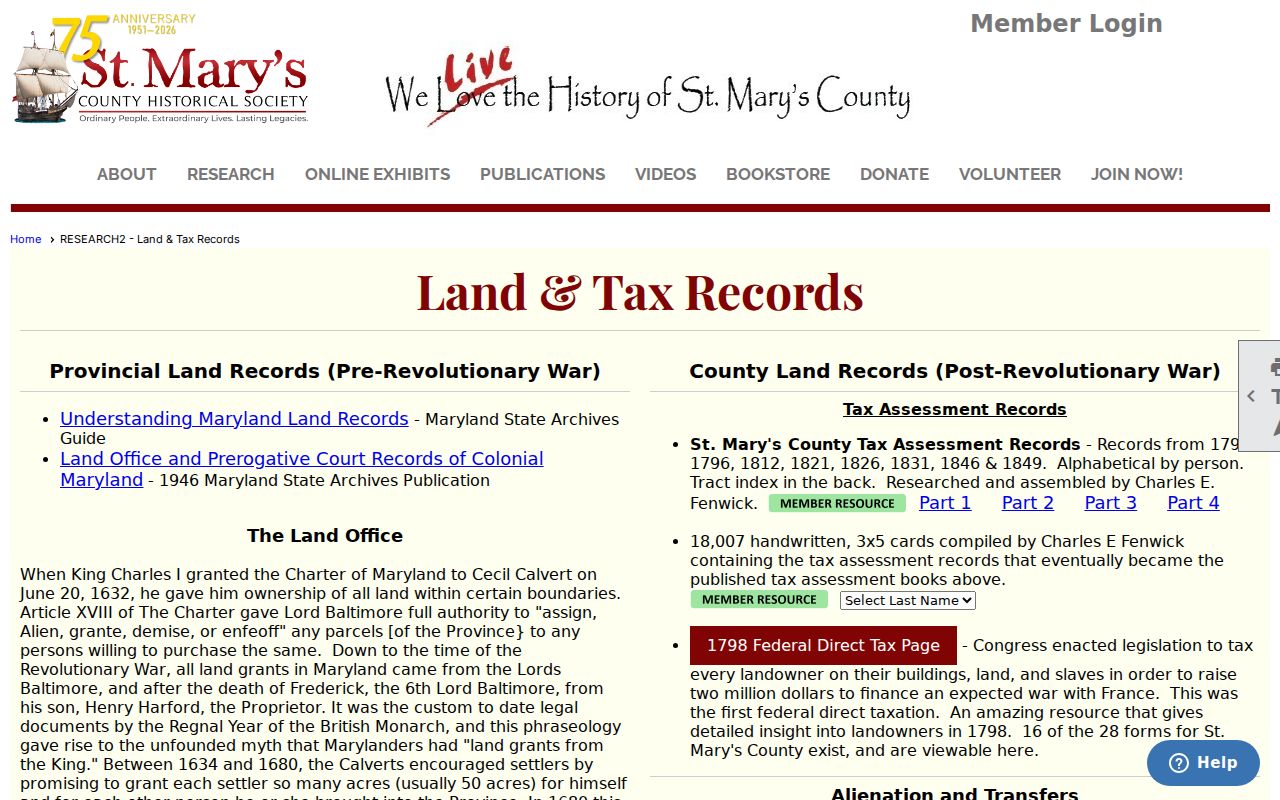
Its debt books, tax lists, and deed-index references help tie old tract names to the later instruments that recorded them.
Plats Supporting St. Mary's Deeds
Deeds in St. Mary's County often lean on plats. A subdivision plat or road plat may hold the boundary detail. So might a lot, block, or historic tract. Plats.net for St. Mary's County offers many search paths. Book and page, plat or box number, right-of-way route, date, description, clerk initials, and Archives series all serve as filters. Its coverage reaches from patents and division plats to county and state road books, subdivision plats, survey records, and plats pulled from land-record volumes.
Road research carries one local quirk. Under HB 744 from 1997, certain proposed public-road title can be accepted through a recorded plat. A separate deed is not required when the statutory dedication requirements are met. That means a road interest may surface in the plat trail while a deed-only name search looks quiet.
The Plats.net search screen lists basic, advanced, and series controls for the county.
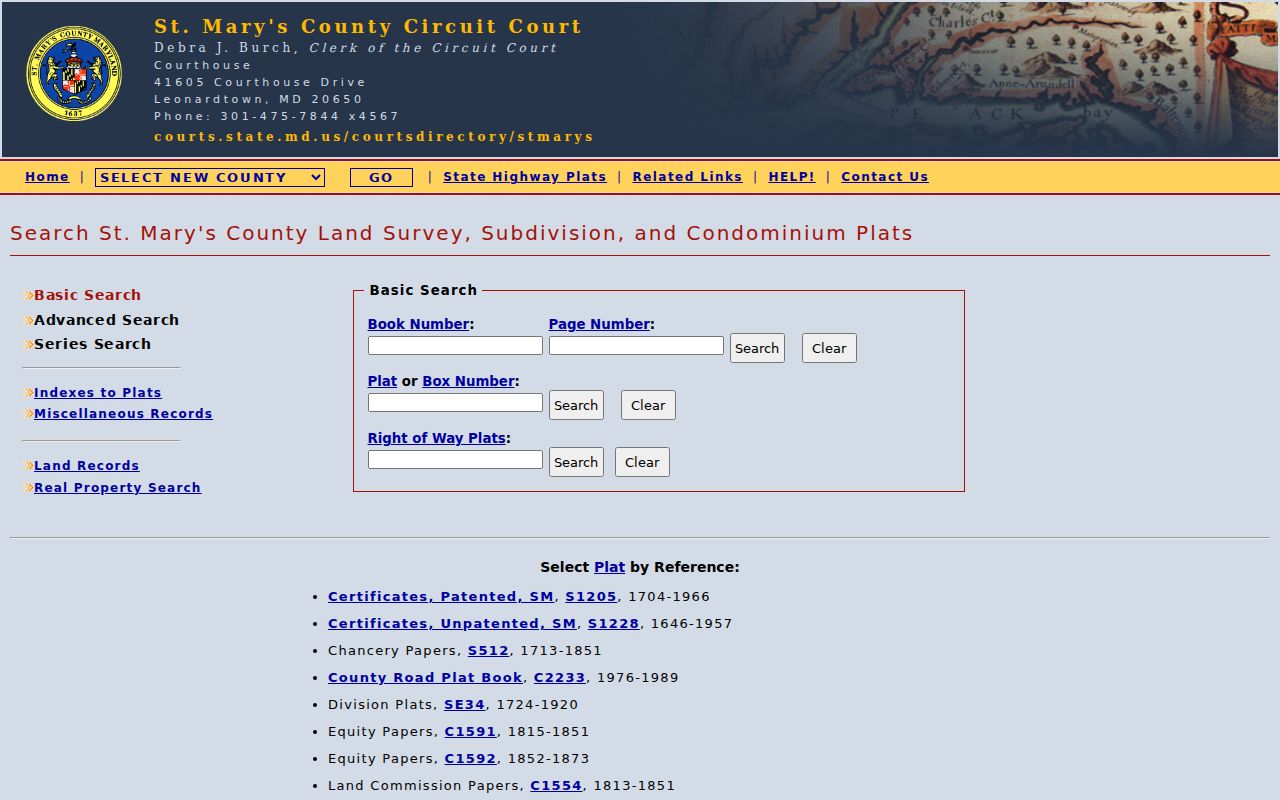
Keep the series name and unit with every image citation so later deed and map comparisons go smoothly.
Monitor St. Mary's Recorded Instruments
St. Mary's County offers no automatic property-fraud alert signup. The practical route is periodic review of MDLandrec plus retention of the last valid Liber/Folio. Maryland's deed-fraud advisory suggests obtaining suspicious land-record copies from the Clerk. It also points to law enforcement, a lender or title insurer, and the proper state agencies when facts support a report.
A parcel reference alone proves nothing. The county's 2026 LUGM scam notice showed that fraud messages can borrow project or property language and still seek a wire. Open the official county or court page yourself. Call a published number. Then compare the claimed instrument or application against the official record.
Maryland's deed and title fraud advisory summarizes those verification steps.
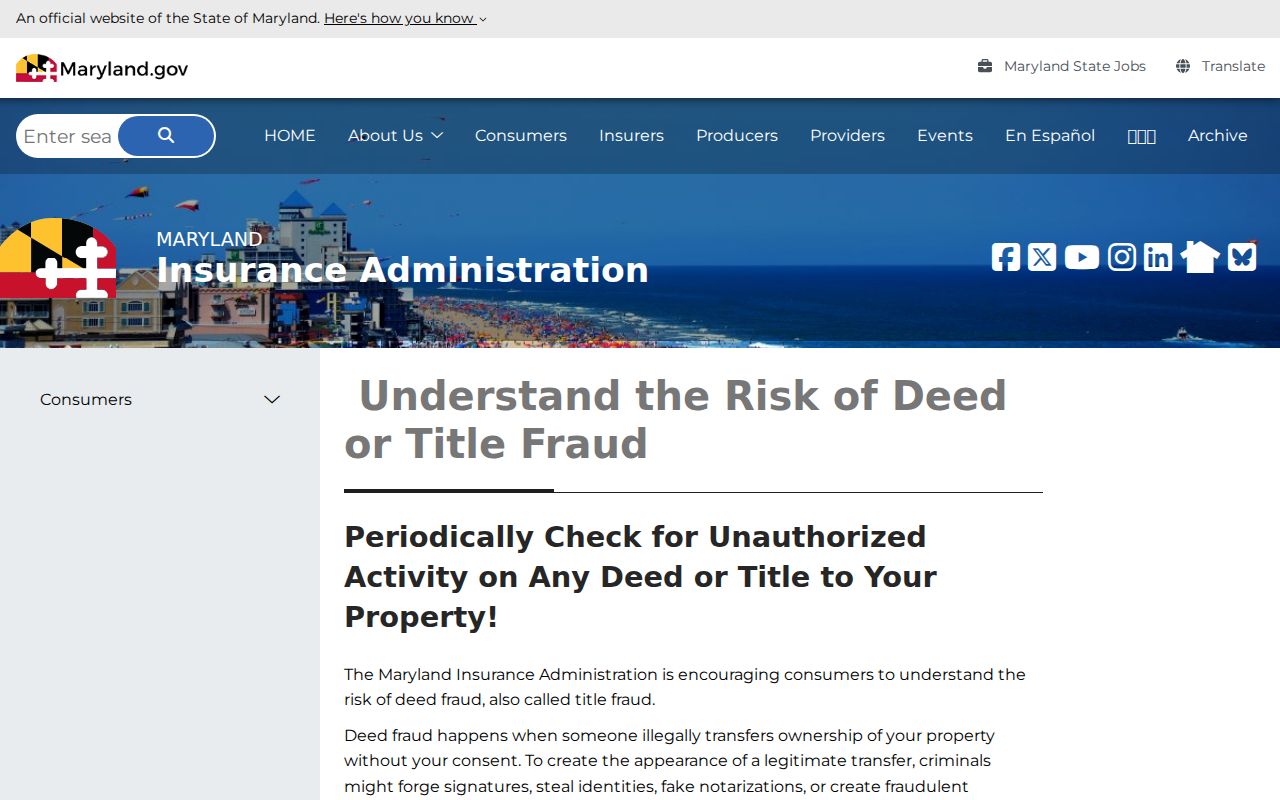
Rely on a saved citation and a fresh comparison, not a presumed alert enrollment.
Obtain a St. Mary's Deed Copy
Online deed images are free to view after login. That assumes the volume is available. Maryland Courts publishes a $0.50 per-page charge for plain paper copies, and certified-copy charges follow the court fee schedule. Give the Clerk the St. Mary's County clerk designation, Liber/Folio, party names, and recording date when known. Precise citations keep staff help focused on retrieval rather than an unauthorized title search.
Leonardtown hosts the in-person fallback. The Circuit Court Clerk offers courthouse terminals and clerk assistance. A request can also travel the contact route published by the St. Mary's Clerk. For older material, Archives finding aids, onsite holdings, microfilm, deed books, and the Historical Society and county library collections open more doors. Ask which copy can be certified before ordering. Research images and certified copies serve different needs.
Recorded is not guaranteed. St. Mary's County deed records show filed instruments, not a title opinion or assurance that no unrecorded interest exists.
For an address-to-account lookup before the deed index, follow the county's property search process. A full chain backward has its own time-depth workflow.