
Compare St. Mary's County Property Value Types
One number rarely tells the story in St. Mary's County. A property value here might be the assessor's market estimate, the phased taxable assessment, an amount written into a recorded deed, or split figures for land and improvements. Check the label, the effective year, and the source before relying on any of them.
| Value Type | What It Means | Where It Is Recorded |
|---|---|---|
| Market assessment | SDAT's estimate of full market value under Maryland rules | SDAT parcel result |
| Taxable assessment | The phased or credit-limited tax input | Assessment and Treasurer result |
| Sale or consideration | The stated amount tied to a transfer, when meaningful | Recorded deed |
| Land and improved value | Separate site and improvement components | SDAT and GIS fields |
Maryland assesses at full market value on paper. In practice the taxable figure can sit well below that mark, since increases are phased in and credits or caps apply. A deed amount carries its own caveats; some reflect nominal or non-market transfers rather than a true sale.
Read St. Mary's Assessed Value Fields Together
A St. Mary's County assessment record lays out several fields at once: Land Value, Improved Value, state and county assessment figures, Next Year Assessment, homestead credit, and transfer activity. Each one answers a different question. Add components together only when the year and record context actually match. Otherwise the total will mislead you.
The county's own parcel metadata service publishes the full list of value, transfer, owner, and parcel fields.
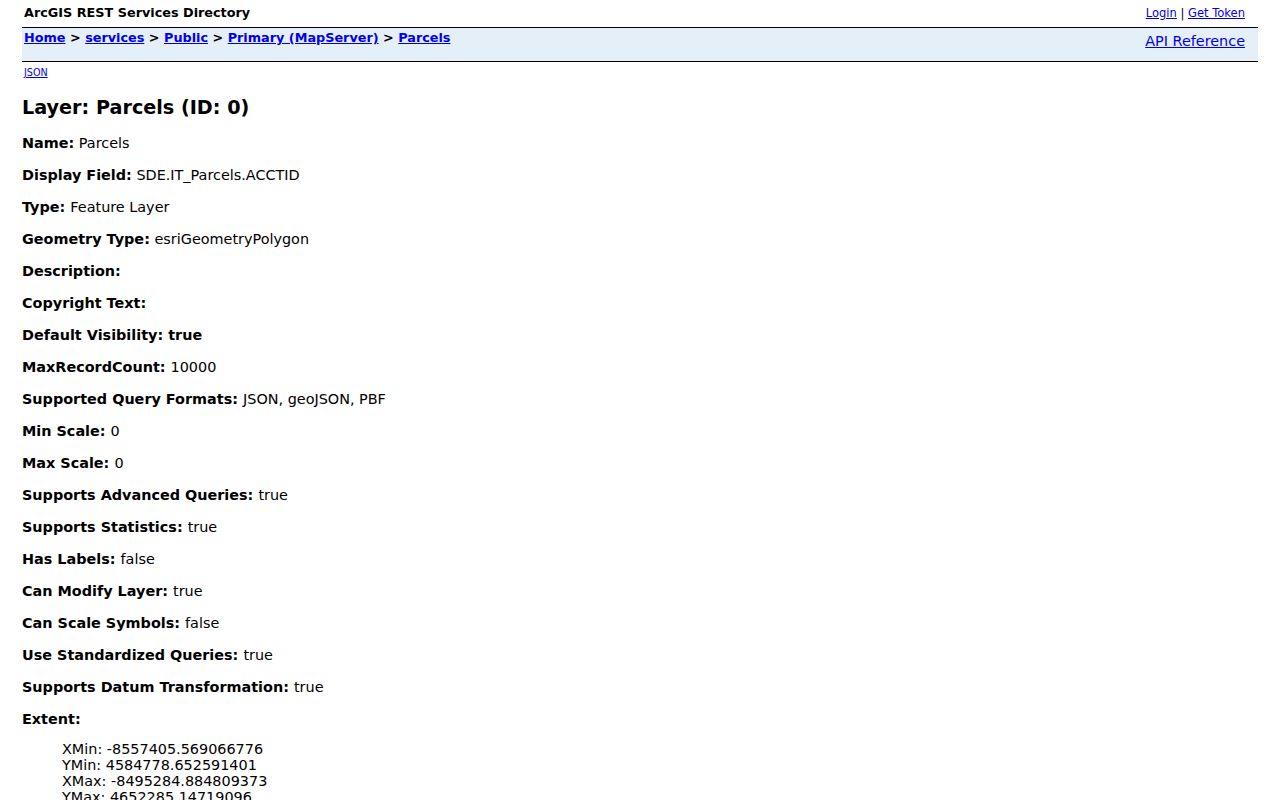
The GIS layer pinpoints the account, but the state Department of Assessments and Taxation holds the authoritative value record for St. Mary's County parcels.
Estimate a St. Mary's County Property Value from Records
Begin with the official assessment data. Bring in sale evidence only when it genuinely answers your question. That discipline keeps an administrative value from getting mislabeled as an appraisal.
- Open SDAT Real Property Data Search and select St. Mary's County.
- Search by street address or Property Account Identifier and confirm the legal description.
- Record land, improvement, market assessment, taxable assessment and effective year separately.
- Check transfer date and the deed only if a past sale comparison is needed.
- Assessed value
- The administratively determined value under Maryland rules.
- Market value
- An estimate of arm's-length value, not a guaranteed offer.
- Assessment ratio
- A sales-study comparison of assessments and arm's-length prices.
- Reassessment
- The periodic review that can change and phase in a value.
Understand the St. Mary's Assessment Ratio
Maryland's FY2025 assessment ratio report put St. Mary's County medians at 94.5 percent residential, 94.0 percent commercial, 94.5 percent agricultural, and 100.0 percent use-value. The weighted total came to 96.6 percent. Those are countywide statistics. No single parcel is promised its category ratio.
The ratio measures how the system performs overall. It is not a formula for converting one assessed value into a dependable sale price.
Note: Two accounts with similar assessed totals can still differ in condition and comparable sales.
Why a St. Mary's Property Value Changes in Stages
Reassessment in Maryland runs on a three-year cycle, and increases are phased into the taxable assessment over time. A July 1, 2024 state table set St. Mary's County's homestead cap at 3 percent and Leonardtown's municipal cap at 10 percent. A cap slows growth for a qualifying account. It never freezes market value.
One St. Mary's County example showed a State Assessment of $329,667, a County Assessment of $317,506, a Next Year Assessment of $329,667, and a county homestead credit of $2,635.82. Those are tax inputs from a single account, not values that transfer to other parcels.
Separate the St. Mary's Tax Estimator from Property Value
The county Treasurer's estimator gathers owner, premises address, state and county assessments, credits, rates, fees, and a total. It puts all of this on one screen. It is a useful window into how a value enters tax math. The bill total, though, is not a second measure of market worth.
The official estimator page displays that layout.
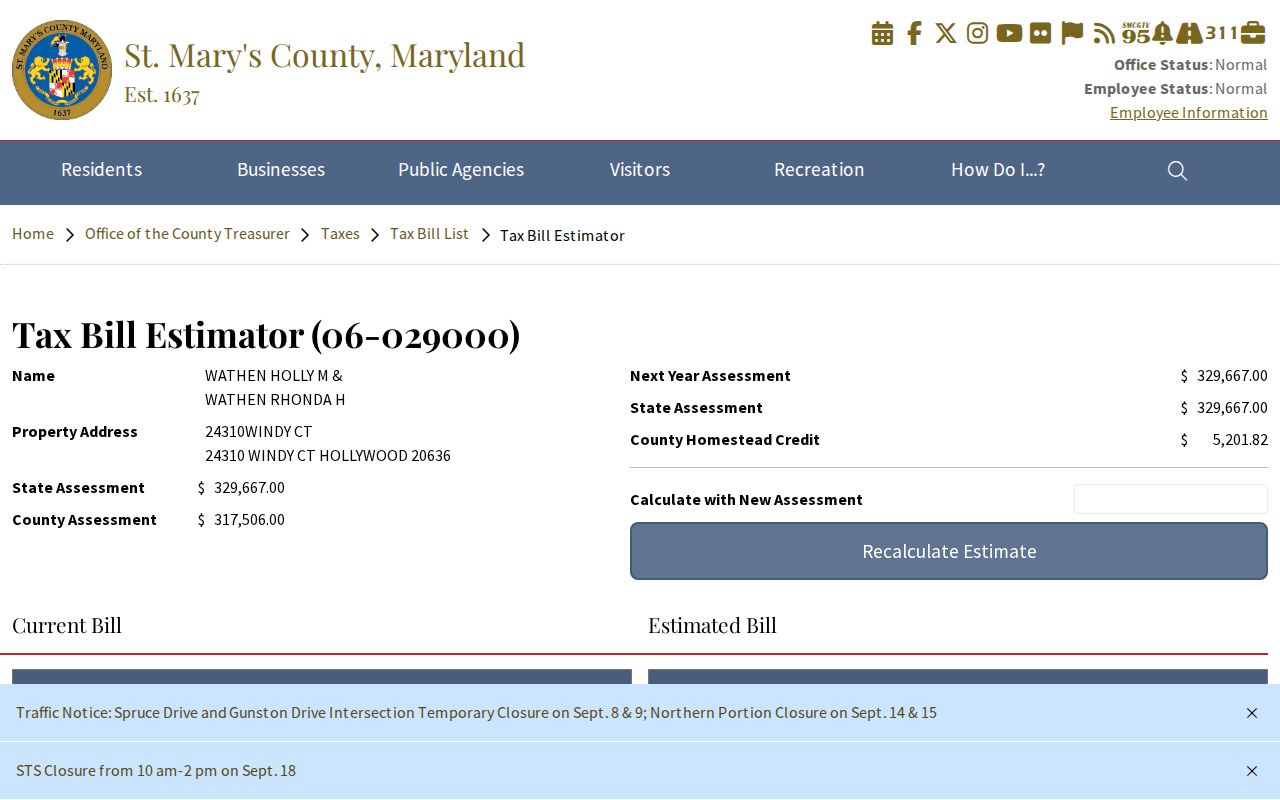
The displayed fields show why assessment, credit and tax total need separate labels.
Compare St. Mary's Property Value with a Recorded Sale
A deed can state consideration and a transfer date. But the assessment and GIS fields do not offer a reliable static sale-price field. That field does not exist for every St. Mary's County parcel. Pull the actual instrument through Maryland Land Records before quoting a price.
Family conveyances, trust transfers, partial interests, and nominal consideration can all skew a number. Any of them can make an amount worthless as a market comparison. Keep the deed type and transaction context alongside the number.
Place St. Mary's Value Data in Peninsula Context
St. Mary's County is peninsula country, so waterfront, floodplain, critical-area, and access questions come up constantly. GIS layers can hint at constraints. They cannot settle an easement, a permit, buildability, or an exact boundary. Those facts shape market judgment without touching what an assessment field means.
Define the parcel with deed and plat evidence before measuring it against another tract. A creek-facing rural parcel is not the equal of an inland platted lot. Matching assessed totals do not make them equals.
Know What a St. Mary's County Property Value Cannot Prove
An assessment cannot promise what a buyer will pay. It cannot document unseen condition, settle a boundary dispute, or replace a dated appraisal. It also fails to explain the full tax bill, because credits, rates, and charges live in separate records.
Assessment is not an appraisal. St. Mary's County assessed value supports tax administration. It is not a guaranteed sale price or parcel-specific professional appraisal.
For bills, credits, and appeals, turn to the St. Mary's County property tax records guide. This page stops at what each value means.
Record a St. Mary's County Value Comparison Clearly
A comparison others can reproduce needs the account number. It also needs the premises address, legal description, value label, amount, effective year, and the date the source was reviewed. Give land and improvement figures their own rows. List a recorded consideration on a separate row. Put the deed type and transfer date beside it. If the public record shows no sale amount, record that absence honestly. Do not import a number from an unsourced listing.
| Parcel identity | Account, premises and legal description |
|---|---|
| Assessment evidence | Market, taxable, land and improvement figures with year |
| Sale evidence | Deed citation, transfer context and any stated consideration |
| Limit | No record value is a guaranteed current selling price |
That structure keeps different St. Mary's property values comparable side by side. Assessment policy, tax calculation, and market evidence stay distinct instead of collapsing into one vague estimate.