
Trace Former St. Mary's County Property Owners
No database offers a single list of every former owner. Past holders emerge from dated conveyances. Start with the current deed citation and identify its grantor, then find the deed by which that grantor earlier took title to the same land. St. Mary's County's 1831 courthouse fire makes the source and coverage period of each older link critical.
| Source | Years It Covers | Where Held | What It Shows |
|---|---|---|---|
| MDLandRec and Circuit Court deeds | Modern portal; exact image cutoff not stated | Online and Clerk | Grantor, grantee, legal description and Liber/Folio |
| CE123 electronic index | 1827-1950 | Maryland State Archives guide | Indexed names and recording references |
| Grantor/grantee originals | 1930-1992 series | Archives and paper/microfilm companions | Original alphabetical index entries |
| Land-record plats C2222 | 1851-1949 | Archives and Plats.net | Survey and subdivision context |
| Abstracts and local tax sources | 1806-1949 and varied earlier runs | Archives and Historical Society | Parties, tracts, value or possession clues |
A twentieth-century chain starts with the latest deed. An early tract is different. Expect to combine abstracts, re-recorded deeds, rent rolls, tax books, patents, probate and plats, without pretending each source proves the same thing.
Build a St. Mary's County Previous-Owner Timeline
A backward timeline keeps every transfer distinct. It exposes a broken link early. Fill each row from actual deeds, leaving the party or citation blank whenever evidence is missing, so a gap never hardens into an unsupported conclusion.
| Transfer Date | Grantor to Grantee | Deed Type | Book/Page |
|---|---|---|---|
| Newest recorded date | Immediate former owner to current grantee | As stated in instrument | Current Liber/Folio |
| Earlier recorded date | Next prior grantor to that former owner | As indexed | Earlier Liber/Folio |
| Gap or pre-fire lead | Label as unconfirmed | Abstract, tax, probate or patent clue | Exact source citation |
Sample dates and names cannot replace parcel-specific entries. The timeline exists to preserve proof and uncertainty together.
Go Back Through the St. Mary's County Deed Chain
Take the grantee from one deed. Search that name for the earlier acquisition. Keep the legal description beside the name, since a prior owner may have conveyed several unrelated parcels.
- Copy the current Liber/Folio from SDAT and open it in Maryland Land Records.
- Read the grantor, grantee, deed type and parcel description from that instrument.
- Search the grantor as an earlier grantee, testing spelling variants and clerk initials.
- Repeat while the land description continues to match; move to index books or archives when web coverage ends.
- Grantor and grantee
- The conveying and receiving parties named in an instrument.
- Chain of title
- The supported sequence of conveyances for the same land.
- Reverse index
- An index organized to locate conveyances through party roles and names.
- Quitclaim and warranty
- Different deed forms whose exact legal effect must be read in the instrument.
Read the St. Mary's Former-Owner Index Entry
Maryland's land records site is the starting point. It offers Indices and Jump to New Volume behind a free Archives account, though the public login screen states no exact modern county imaging cutoff. Describe the volume you actually find. The official land-record portal shows its entry screen for registered users.
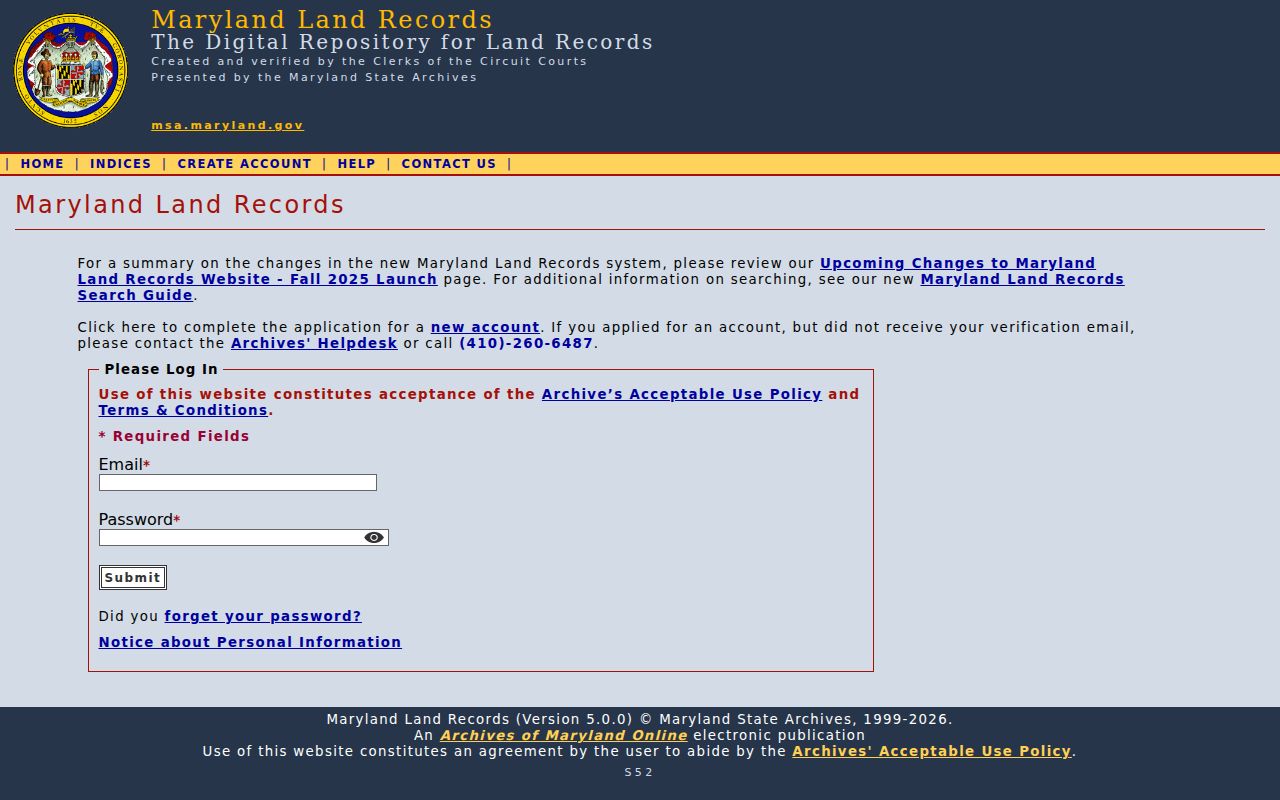
The index only supplies the route. The deed image and its parties support each link.
Note: Free online viewing and a clerk-certified copy are different products; use the clerk-certified copy whenever certification is required.
The 1831 Fire Break in St. Mary's Ownership History
On March 8, 1831, a courthouse fire destroyed most surviving early court and land records. A trail that reaches that date may stop cold. The land itself may be far older. The Historical Society reports that deeds from 1637 to 1831 were lost, except re-recorded material beginning in the late 1700s.
Coverage limit. The electronic index series begins in 1827, but that does not mean every deed image survives or that every earlier owner can be recovered.
State Archives land abstracts covering 1806-1874 and 1874-1949 may preserve parties, property, amounts and recording dates; label each one as an abstract, never as a lost original. An abstract is a lead, not the record itself.
Reconstruct St. Mary's Former Owners from Local Collections
The St. Mary's Historical Society land and tax collection includes alienation or transfer material, debt books, tax assessments, deed indexes, surveyor journals and 18,007 handwritten Fenwick cards. A single card can connect a person to a tract name where courthouse evidence is broken. These are leads. Test them against surviving recorded or court sources.
The county library's Maryland Room holds newspapers and microfilm. Obituary resources there can supply a date or family relationship that identifies the right probate file.
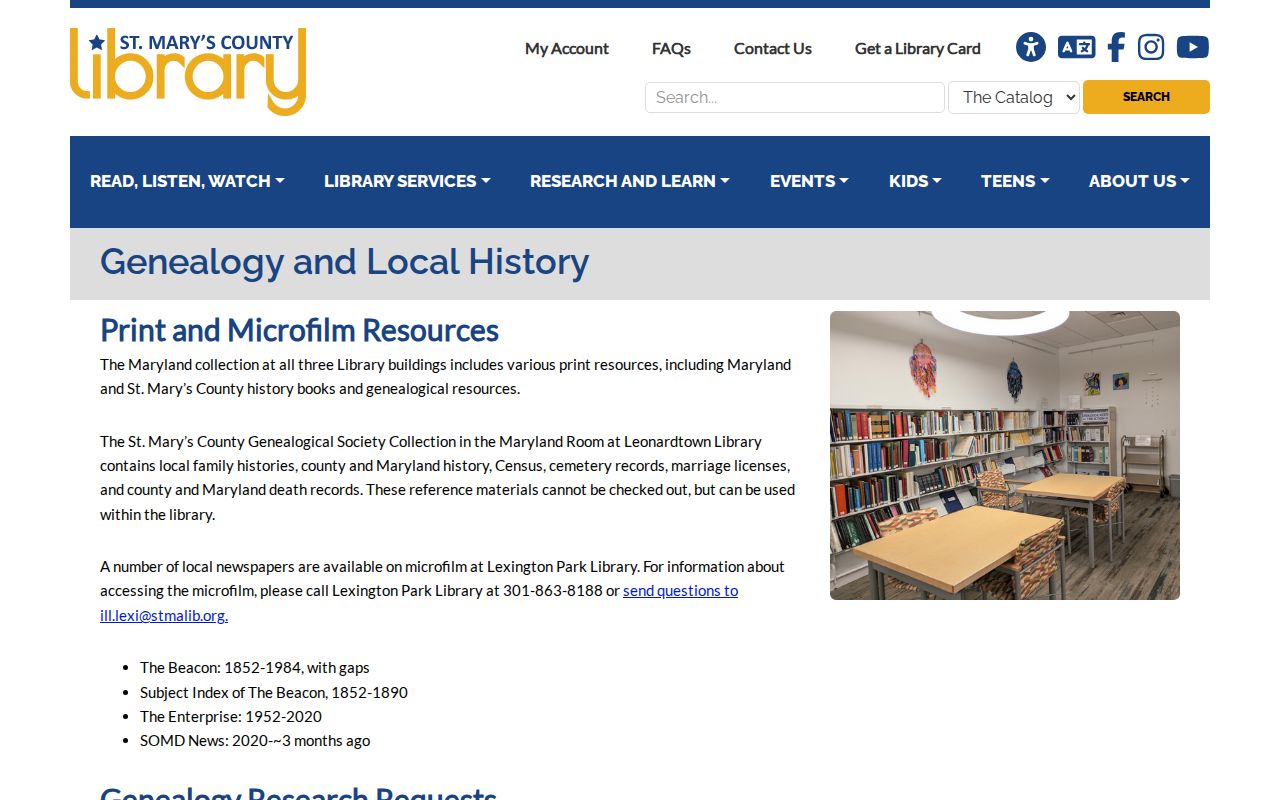
The library collection adds context and search clues, not a silent substitute deed.
Use St. Mary's Plats to Follow a Changing Tract
Old deeds rarely carry modern addresses. Search Plats.net for St. Mary's County by description, book/page, date, clerk initials or Archives series, and match the old tract or subdivision lot to the current map, grid, parcel and account.
The Archives plat finding aid documents survey and subdivision plats from 1851 through 1949.
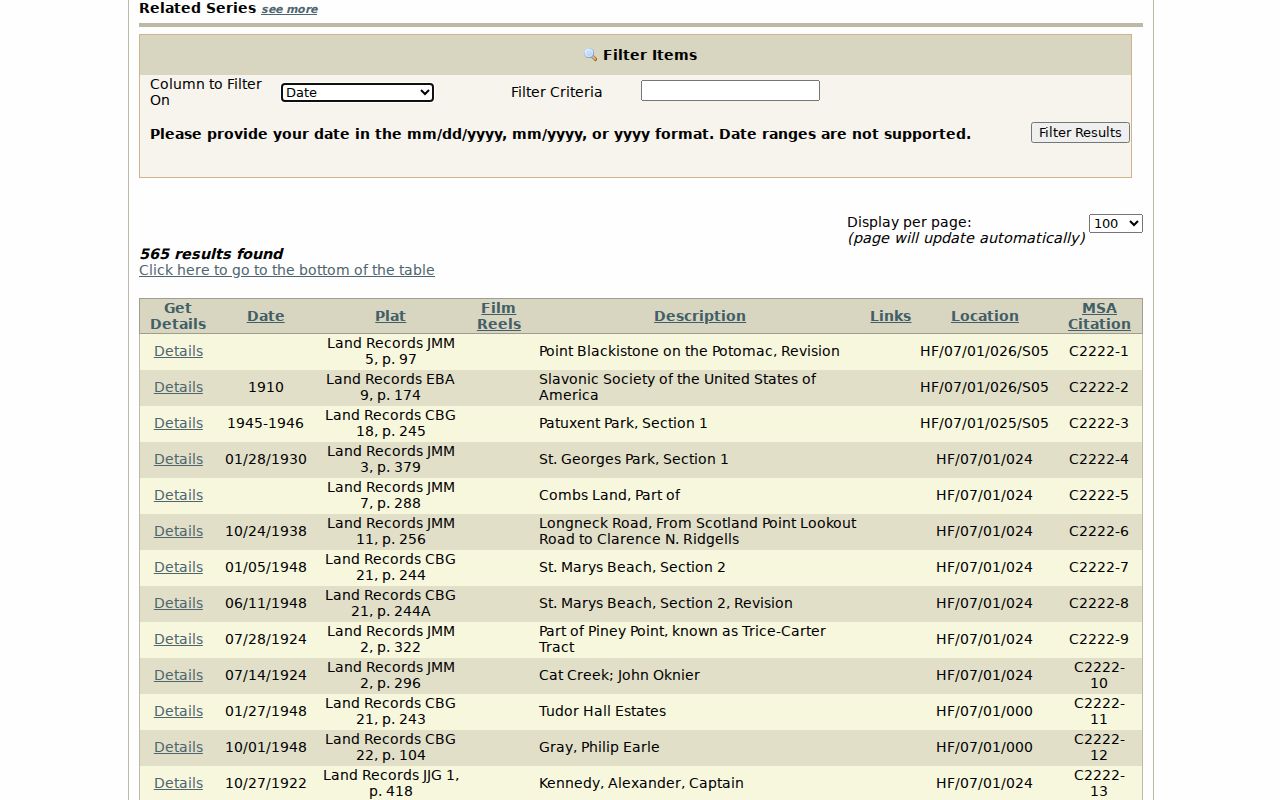
Named anchors help. Patuxent Park Section 1 sits at CBG 18 page 245, and St. Georges Park Section 1 at JMM 3 page 379. A precise plat citation beats any nickname.
Restore a St. Mary's Previous-Owner Link Through Probate
A death can interrupt a neat grantor-to-grantee pattern. Search the Maryland estate index by decedent and county. Then inspect the Register of Wills file for a representative, inventory, petition, distribution or court-authorized sale. Go back to land records. There the deed or order actually connects the estate event to the parcel.
Note: A will or tax assessment can identify an interest, yet neither automatically proves a completed fee-simple conveyance.
How Far Back St. Mary's County Former Owners Can Be Traced
The honest answer depends on the record type. The electronic index starts in 1827. Abstracts reach earlier and overlapping periods, and colonial rent rolls or patents can still name a tract or possessor. The 1831 loss rules out any blanket promise of an unbroken chain, so preserve source type, citation and confidence on every line.
Lawful use. Former-owner research supports house history, estate work and property diligence. Never use a historical chain to track, intimidate or harass a living person.
Need one instrument's recording details? For a copy and full citation, use the St. Mary's County deed records guide.