
Inside St. Mary's Property Tax Records
Two offices split the work. The Maryland State Department of Assessments and Taxation, or SDAT, certifies the assessed value. The St. Mary's County Treasurer issues and collects the bill. Treating a market assessment, a taxable assessment, and the final bill as one figure is the most common reading error. A county result keeps them separate, listing State Assessment, County Assessment, Next Year Assessment, credits, rates, fees, and the total due.
| Field | What It Shows | Where |
|---|---|---|
| State and county assessment | Certified value inputs, which may differ during phase-in | SDAT and tax estimator |
| Land and improved value | Separate values for land and improvements | SDAT parcel record |
| Credits and caps | Adjustments applied to taxable growth or the bill | SDAT and Treasurer |
| Rates and charges | County, state, fire, rescue, bay, and waste items when applicable | Treasurer bill |
| Status and tax sale | Payment context or a published delinquent-sale row | Treasurer |
Maryland assesses real property at a full-market-value standard. Caps and credits can hold the taxable figure well below it, though. A bill is not a sale price. Recorded consideration is a separate clue, and it can reflect a non-market transfer. For a side-by-side comparison of those figures, turn to the county's property value record.
Search St. Mary's Assessments
The SDAT Real Property Data Search is free. Pick St. Mary's County, code 19, then choose a search method. You can search by street address or Property Account Identifier, with owner-name and map/parcel routes offered where the service renders them. Deleted accounts surface only through the identifier, so save that stable key.
| SDAT field | When to use it | St. Mary's detail |
|---|---|---|
| County | Sets jurisdiction | St. Mary's, code 19 |
| Street Address | Starts from a known site | Try directional and suffix variants |
| Property Account Identifier | Finds one account | Only route for deleted accounts |
| Owner Name | Finds an indexed party | Test trust and entity variants |
A result can show owner, situs and mailing address, legal description, Liber/Folio, transfer activity, land and improved values, and assessment fields. Save your search date. The SDAT search screen displays the county and search-method selectors.
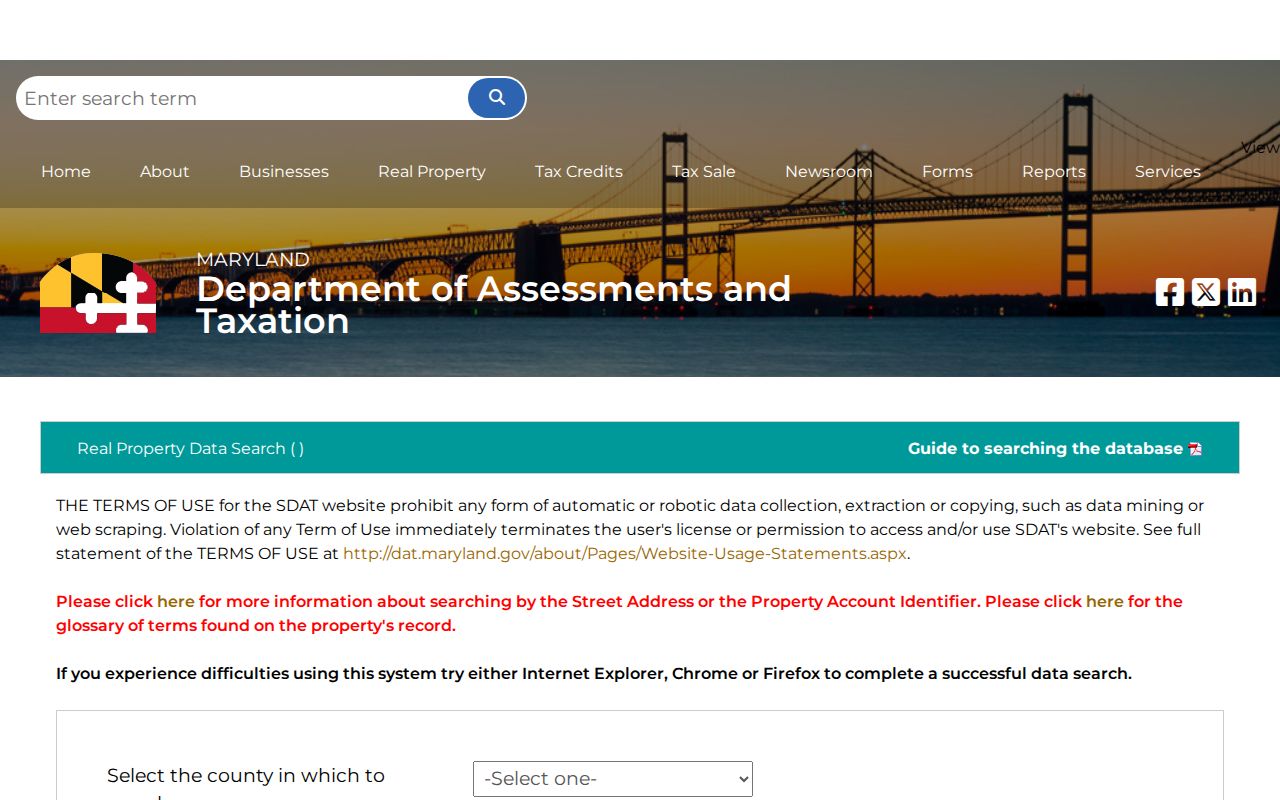
This first result supplies the account used to reach the county bill.
Read a St. Mary's Tax Bill
The St. Mary's County Treasurer runs the tax side. Lookup, payment, credit, and tax-sale routes all sit with that office. The tax year runs July 1 through June 30, so match the SDAT account's owner, situs, and assessment to the Treasurer result before using any total.
- Copy the exact SDAT account, owner display, and situs address.
- Open the Treasurer result and match those identifiers.
- Read each assessment, rate, charge, credit, fee, and total.
- For delinquency, check the tax-sale route and verify current status with the Treasurer.
- Market assessment
- SDAT's estimate under Maryland's full-value standard.
- Taxable assessment
- The value used after phase-in, caps, or credits.
- Levy or rate
- The rate applied to the relevant assessment base.
- Homestead credit
- A limit on taxable-assessment growth for an eligible principal residence.
- Tax lien
- A government claim tied to unpaid tax, not a completed ownership transfer.
Card payments add a 2.5% convenience fee. ACH adds none. The Treasurer counter in the Patuxent Building, open weekdays from 8 a.m. to 4:30 p.m., can confirm a payment the online system has not yet posted. The sample tax estimator lays out separate assessments, credits, rates, and the total.
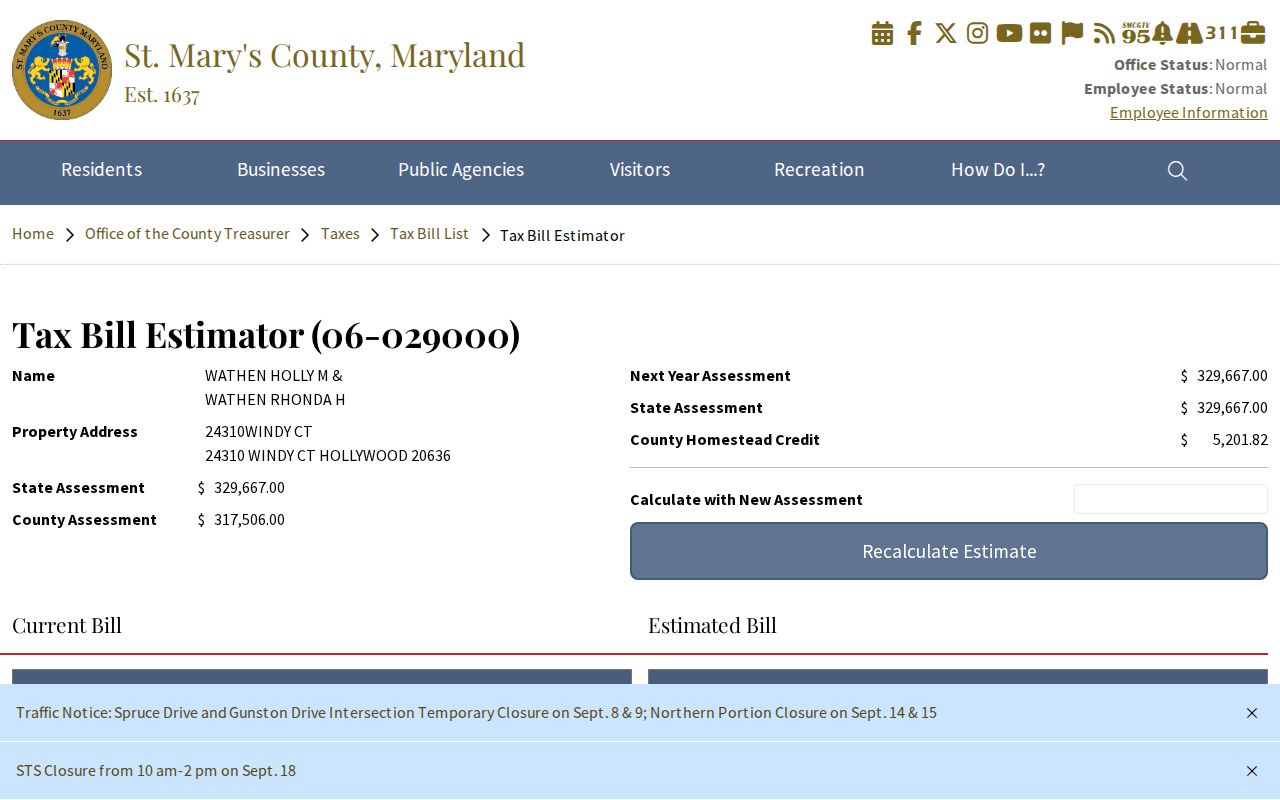
Every line on a St. Mary's County tax bill adds a charge the assessment alone never shows, from county and state rates to local fees and credits.
St. Mary's Homestead Caps
Maryland's homestead credit limits how fast the taxable assessment can rise on an eligible principal residence. It does not freeze market value. A July 1, 2024 published table sets a 3% cap for St. Mary's County and a 10% cap for Leonardtown. A parcel inside town limits may be treated differently. A Leonardtown mailing address does not prove the land lies within the town. Confirm the legal jurisdiction.
Maryland also runs homeowners, senior, and veteran-related tax-credit programs. Each sets its own rules. A line item proves an adjustment was applied, but public property tax records do not establish the personal facts behind an application, so verify any credit against the real assessment and bill. Qualification questions belong with SDAT or the program administrator.
St. Mary's Reassessment Cycle
Maryland reassesses real property on a three-year cycle and phases increases into the taxable assessment. The reassessment notice starts the appeal clock. In a non-reassessment year, an owner can instead use SDAT's petition-for-review process. Solid evidence matters. Strong appeals lean on correct property characteristics, condition facts, and comparable sales, since a high bill alone never proves the valuation wrong.
Ratio reports offer context. They are not a parcel formula. The FY2025 report shows a 94.5% residential median and a 96.6% weighted total for St. Mary's County. Those figures compare assessment groups with arm's-length sales. No fixed share applies to every parcel.
St. Mary's Delinquent Tax Rows
The county's St. Mary's tax-sale page lists delinquent accounts with owner names, locations, assessments, taxes due, notes, and map links. A row is a delinquency signal. Title loss is not automatic. Payment, redemption, court action, or a later deed can still change the outcome.
The county also posts annual auction details and describes sales as is. Note the search date. Check each row against SDAT, GIS, and land records. The tax-sale account string should not be assumed identical to the SDAT identifier until those sources agree. The published delinquent tax table shows the fields open to cross-checking.
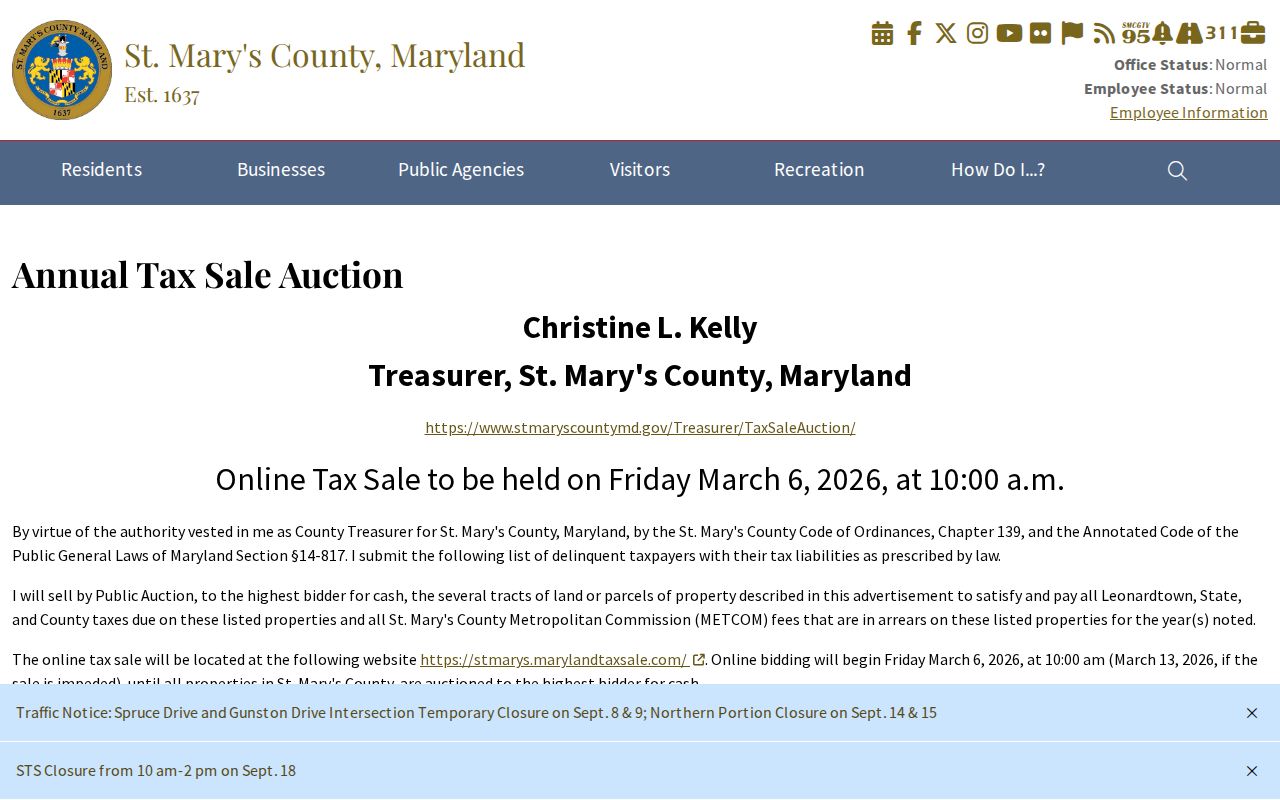
The map link helps you locate the parcel. For current status and title, rely on the Treasurer and the recorded deed.
Contest a St. Mary's Assessment
St. Mary's owners can challenge an assessment. The Maryland online appeal form starts the process. It asks for county, notice number, and control number. File the initial appeal within 45 days of the notice. Later stages, from supervisor review through the Property Tax Assessment Appeal Board to the Maryland Tax Court, each carry their own deadline and record. Gather the notice, parcel account, property details, photos or condition facts, and comparable sales; SDAT notes that assessment worksheets and comparable-property information may be available, though a nominal charge can apply to some worksheets. Payment problems belong with the Treasurer. Value disputes belong with SDAT. The state appeal screen lists each required field.
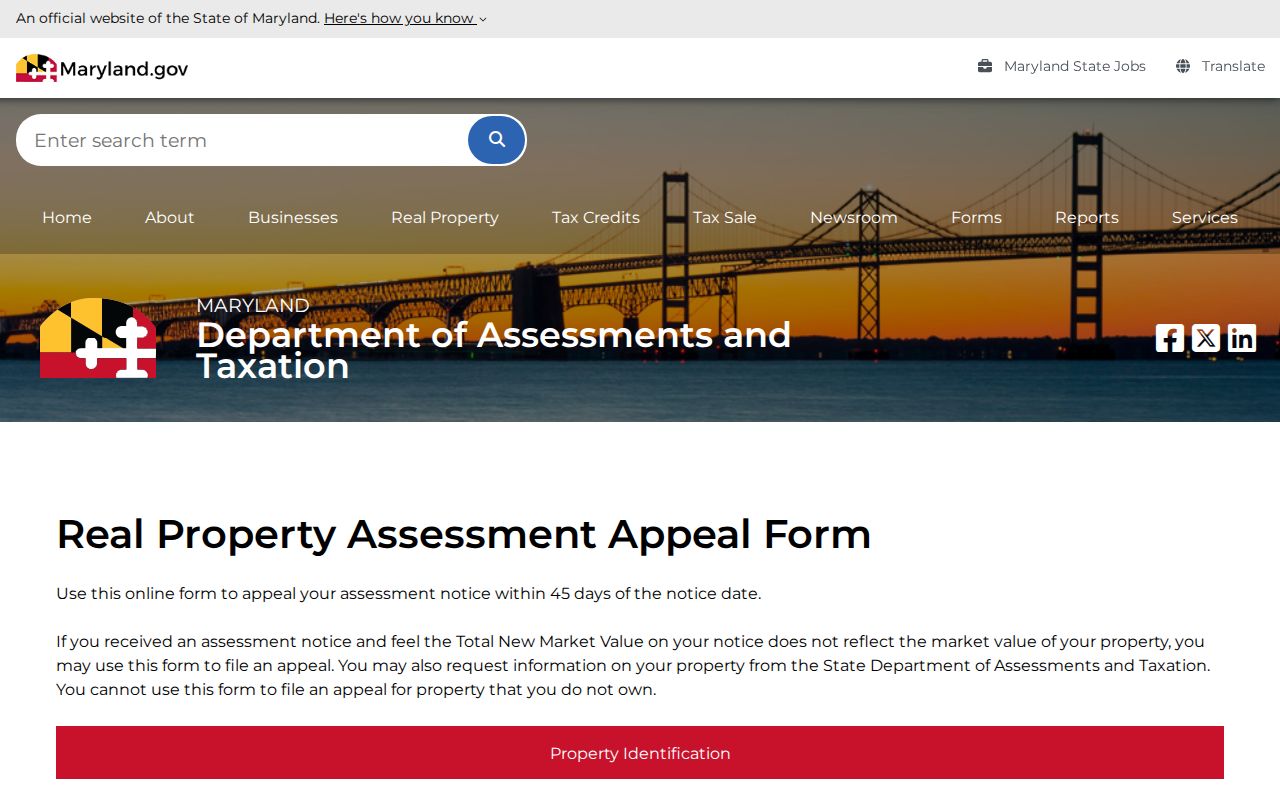
Hold the assessment notice; it anchors the St. Mary's appeal.
Watch the notice date. A St. Mary's reassessment appeal must begin within 45 days; later stages have separate deadlines.
Not everything needs a screen. The local SDAT office in Carter Building Room 2059, 23110 Leonard Hall Drive, Leonardtown, handles offline assessment records and value help. Call (301) 880-2900 or email sdat.stm@maryland.gov. Office hours run weekdays from 8 a.m. to 4:30 p.m.
Offline St. Mary's Tax Access
Online tax records are only one channel. The Treasurer's counter at 23150 Leonard Hall Drive handles bill and payment questions during weekday office hours. Assessment records and value questions go to the local SDAT office. A narrow Maryland Public Information Act request can reach county-held data that no public screen shows, subject to lawful exemptions and reasonable search or copy costs.
Older tax history lives elsewhere. The St. Mary's County Historical Society holds assessment lists from 1793-1796, 1812, 1821, 1826, 1831, 1846, and 1849. The lists name people, tracts, and taxable interests. They do not prove present title. Compare each clue with land records, plats, probate, and later assessments before tying it to a modern parcel.
Keep any request narrow. Name the account, tax year, fields, and date range. That detail lets the custodian tell a bill copy from a data request and makes the result easier to reproduce.